


current turmoil in our health care delivery system is at a level requiring an immediate and carefully considered response. With so many different components, often in competition and/or conflict with each other, meaningful solutions are difficult to envision. As many critical elements involved with the provision of health care vary widely from state to state, it may well be that restructuring health care in Minnesota can happen only through actions taken in Minnesota and these may be best led by our state governor. Health insurance plans are exiting the field in Minnesota and those remaining are projecting double digit premium increases. The recent national failure to renew the Affordable Care Act will result in thousands of low-income Minnesotans unable to afford coverage. Both the public and private sectors should be concerned about this moral and economic dilemma. Uninsured families will still need basic health care and won’t be able to pay the high costs. Consequently, hospitals and medical practices will experience millions in uncollectable billing, and some will be forced to close specific units to protect themselves from the financial burden. This is an immediate problem in rural areas where hospitals are already limiting services and closing service lines because they can’t afford to keep them open given the low patient volume. This health insurance crisis is now at our front door and we need to respond. The far-reaching implications of these issues rise to the level where the state legislature needs to respond. The financial crisis supersedes the risks a new program might bring to restricted budgets. Consequently, an innovative new approach needs to be developed that will reduce health care costs and result in lower insurance premiums while protecting quality and access to care. A well-designed state program would not only lower health insurance premium costs but would also improve the efficiency of the provider system.
Cover one
Health Care Reform
A plan that could work
By John Kralewski, PhD, MHA

What Research Can Tell Us
Many recent studies provide insight into these issues. First, the research is clear that provider costs can be reduced by at least 30% from limiting the use of services, and especially technologies, that make little or no contribution to patient health outcomes. There are several factors driving this waste. Hospitals and physicians make more money by these high utilization patterns, patients are unable to determine if they are needed and legal considerations favor overuse. For example, the overuse of imaging technologies including MRI procedures and CT scans when unrelated to a patient diagnosis. This overuse is often related to the ownership of these technologies. There is a significant increase in use if the technology is owned by a medical clinic or the medical practice is located next to a hospital. All of these data were adjusted to correct for case mix of patient illnesses. Scheduling fewer patients per hour also improves quality and reduces costs by having time to involve patients in their health care. Another factor increasing costs is that physicians are spending too much of their time treating patients with minor illnesses that can be treated by nurse practitioners or even registered nurses using care guides. Several studies have found that the employment of nurse practitioners by primary care medical group practices reduces costs and improves quality of care as well as patient satisfaction. Team care is gaining traction but most of the training programs still prepare nurse practitioners and physicians to practice independently. Consequently, when medical practices add nurse practitioners, they often fail to develop the team concept and costs increase rather than decrease. One recent research study found that one NP per physician lowers cost, however two per physician often increases costs because they tend to be used as assistants rather than independent providers.
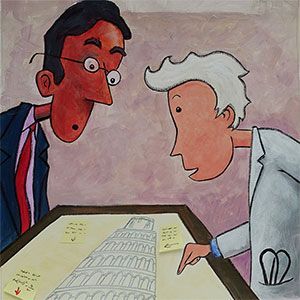
Physicians are spending too much of their time treating patients with minor illnesses that can be treated by nurse practitioners.
The lack of adequate primary care clinician training to both provide and manage patient care is an important cost and quality factor because they control nearly 70% of total health care expenditures. In addition to their clinical decisions, they decide when to refer their patients to specialists and which specialists provide cost effective care. The savings achieved by well- managed primary care clinics is not trivial. One study found a 40% difference in the total cost of care provided and managed by primary care medical group practices after adjusting for differences in patient level illness and differences in reimbursement rates. An important additional finding was that quality is not found to be related to those cost differences. Differences in reimbursement is an especially troublesome challenge for patients with deductible provisions in their health insurance plans. Out-of-pocket payment for a routine clinic visit could vary as much as $50 depending on the patient’s health insurance’s negotiated contract with their clinic. And even more important, data related to these cost differences are not available to patients. Access to primary care is also an issue. Wait time for clinic appointments is often two weeks or more and phone calls are not returned until the end of the day. Consequently, patients often go to emergency departments for their primary care. This of course increases costs.
A Working Template
So, how could legislative leadership in Minnesota resolve these issues and create a better health care system? A good place to start would be to learn how the Fairview health care system developed its innovative model 10 years ago, designed to improve primary care. Their first analysis focused on the expected workload. This was accomplished by reviewing patient visits during the last six months from the electronic medical records, identifying the reason for the visit and the treatment provided. A review of these data, by a committee of nurses and doctors, found that about 30% of the visits could have been handled by nurses using care guides. Another 25% could have been dealt with by nurse practitioners, leaving only 45% requiring physician level training. They also found that at least 40% of all visits could be resolved by phone rather than a clinic appointment.




The next step was to reconfigure the clinics organizational and physical structure to support this expanded team approach to providing care. Was this successful? Yes and no. Total cost of care for patients adjusted for illness level was 38% lower than the control practices and patient satisfaction was 30% higher. However, they were never able to get the health insurance plans to pay for services provided by nurses or even some phone visits and they had to return to a traditional care model. Can the Fairview experience and related research focused on medical group practices be used to develop a competing low-cost high-quality health care option with broad access to care?
We know that some primary care medical group practices provide high-quality care at lower costs. We also know that the high-cost practices can be expected to resist changing their practice styles as long as they attract patients and insurance plans or patients pay the higher cost. So how can enough patients be convinced to select lower cost primary care practices to cause the others to change as they lose patients. Passing the savings on to patients who choose low-cost practices would seem logical, but how can that be done? An innovative program developed by the health insurance plan for state employees has promise as a response to this issue. That plan was designed to protect enrollee choice of physicians and access to care while providing economic incentives to select low-cost practices. The health insurance plan accomplished this by creating three categories of primary care practices serving their enrollees based on cost and quality data available from their records. Enrollees are required to select a primary care practice and a physician in that practice to provide and manage their care. They could change physicians and even practices but needed to stay in the selected tier unless they wanted to change tiers. If enrollees selected a physician in the lowest cost tier that also met the plan’s quality standards, all care is fully covered. Coverage for those choosing the second-tier practices includes co-pays, and enrollees selecting physicians in the highest cost tier includes both co-pays and deductibles. This not only reduced the overall cost of the health insurance plan, but it also caused the high-cost physicians to review their practice styles as they lost patients.
Political leadership in Minnesota should welcome this opportunity to further the state’s historically innovative culture.
One of the attractive attributes of this approach is that it doesn’t require major organizational change, and unlike some HMOs it retains free choice of physicians from a large set of providers. Health insurance plans can easily calculate physician practice cost and quality measures from their claims data and can work with high-cost practices to help them get into a lower cost tier. All of this should be welcomed by self-insured companies because it lowers costs while protecting employee access to high-quality health care provided by their choice of physicians. Changing established institutional patterns of health insurance in Minnesota, however, will be difficult as most of the current plans are doing well financially and have no incentive to offer a competing plan. Moreover, some physicians might claim that this program places limits on how they practice and results in lower quality of care so quality needs to be continually monitored.
This new concept needs some high-profile agency to champion adoption. Highly respected hospital-based systems such as Fairview might find it attractive as their self-insured program for their employees but that wouldn’t open the plan to others. The health insurance plan provided for state employees would be a natural sponsor because their plan already has many of these features. The state government could offer this program as an extension of its existing health insurance plan and contract with a private sector entity to market and manage it. Perhaps UCare could be reconstituted and assigned this role. With the current projected large increases in health insurance costs there is an urgent need for a competing plan, and the state legislature should take the lead in responding to this opportunity. Moreover, they can do so without breaking the state budget by establishing a supporting premium that still would be 30% less than the commercial plans and protecting the plan from adverse selection by reviving the state program for enrollees with high-cost health care needs funded by a small tax on all health insurance plans.




Political leadership in Minnesota should welcome this opportunity to further the state’s historically innovative culture. This should be an especially important motivator for our legislature. Minnesota is widely recognized nationally and even internationally for being innovative. This includes technologies in industry and manufacturing, the development of HMOs and the medical group practice concept in the health care field and the clinical breakthroughs developed by the university physicians and the Mayo Clinic.
An important dimension of this state model is that it provides a mechanism and leverage to influence some other changes in health care financing and delivery. For example, we know that prescription drug companies will negotiate lower prices if they can count on a guaranteed volume and that agreeing on one brand of an expensive drug often provides that needed volume. Since prescription drugs account for nearly 15% of health care costs this proposed health insurance plan could reduce these costs and further reduce their premium. The leverage of this health insurance plan would also enable it to strengthen rural health care in Minnesota. A good place to start would be to invite rural community leaders to meet with the health insurance plan to start discussions about the changing rural environment and realistic expectations for health care in their community given the rapidly changing rural economy and the need to maintain access to medical and surgical specialty service that are shifting to larger communities. Trade centers are shifting and the locations of many health care providers are following those trends. Small farming communities do not have a large enough population to support a physician but could become linked to a clinic 20 miles away with a nurse practitioner and perhaps a nurse doula located on site and linked electronically to the parent clinic. These discussions backed by lower health insurance costs and flexible payment plans would likely generate several rural health care models. What we know is that one model does not fit all and that local planning along with flexible payment plans are key factors. Our legislature should recognize this exceptional opportunity to create meaningful health care reform for the citizens of Minnesota.
Conclusion
Development of the model discussed in this article involves major changes and will require an extensive effort to generate bipartisan political support. The health insurance crisis, however, requires urgent action. An attractive immediate response would be to open the current state employees’ health insurance plan to all Minnesotans with incomes at or below twice the poverty levels. That would go a long way in resolving the problem and would signal to Washington that we still know how to be creative.
John Kralewski, PhD, MHA is a professor emeritus at the University of Minnesota, where he was the founder and director of the Center for Health Services Research in the School of Public Health for more than 30 years..




















MORE STORIES IN THIS ISSUE
cover story one
Health Care Reform: A plan that could work
By John Kralewski, PhD, MHA
cover story two
Social Workers in Cancer Care: An important new member of the care team
