


edical science is advancing more rapidly than at any time in history; with this it is important that we also advance our fundamental understanding of the role of health care in our society. We should ask the question of why the well-being of families, children, individuals and older adults is not only vital for each person, but also for society itself. We can answer this question by looking within the U.S. constitution.
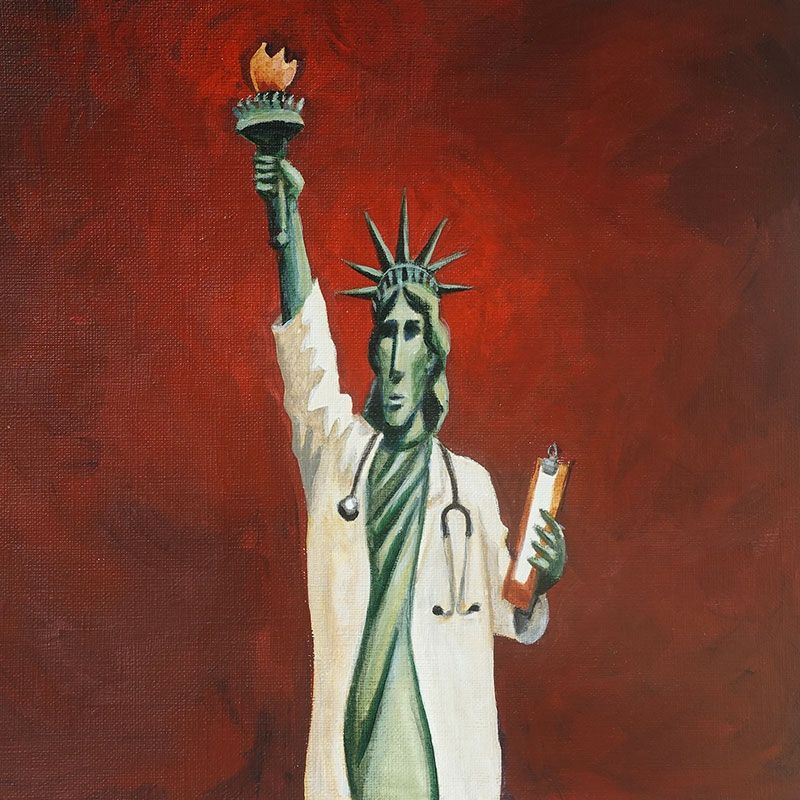
Cover one
The Civics of Health Care
7 Life sustaining dimensions
By Jesse Bethke Gomez, MMA

Today the United Nations recognizes 190 constitutions worldwide and all are designed to provide laws and governance. Presumably ours was designed to protect the basic rights of American citizens. It established a government based on popular sovereignty (“We the People”) and natural laws that are immutable, such as those put forth in the Declaration of Independence, including the inalienable rights of life, liberty and the pursuit of happiness. Our constitution identifies the importance of the role of government in protecting its people and ensuring that we all benefit from fundamental, inherent rights that cannot be transferred, surrendered or taken away by the government.
If we look at Minnesota’s constitution, Article I of the Bill of Rights states “Government is instituted for the security, benefit and protection of the people, in whom all political power is inherent, together with the right to alter, modify or reform government whenever required by the public good.” The constitution creates a through line for laws that create government and the basis by which it seeks to organize for the security, benefit and protection for its people. While this appears to be the basics of a civics lesson, there is more here when we begin to see the connections of various sectors and systems within a society to the constitution itself.
Health care must be perceived as an inalienable right.
Looking at Direct Care
Working on health care means working on tough intractable communal and societal issues. Among the most important are complex humanitarian crises such as the current severe direct care workforce shortage. As we search for ways to address this we must start by looking at the increasing level of human suffering that is growing due to the crisis. It is about understanding the complexities of systems that need to be addressed and understanding causation. Such matters require a multidisciplinary approach involving teams with expertise in areas that intersect at an interdependent system level.
What does this term multidisciplinary approach mean? It refers to bringing experts from an array of fields that become part of a team to understand causation and the interrelationships between various systems and sectors. It presents an opportunity for health care leaders to think in new terms and build a system of profound knowledge wherein we approach health care issues with a variety of perspectives. From this approach solutions become three dimensional, and the result is not simplicity but clarity.
Early in my tenure as CEO for Metropolitan Center for Independent Living (MCIL), I met individually and with groups of people with disabilities. Many of these people shared a growing anxiety related to the lack of direct care workers and how this affected their daily living. It was creating a worsening crisis.
We know there is a growing workforce shortage; there are not enough direct care workers to assist people with disabilities or older adults who rely upon direct care services for daily living.
Approaching this in terms of the interrelationships between various systems is critical to the many high-level health care commissions, panels and appointments that are involved in advancing better health care. To pursue a deeper understanding of the growing direct care workforce shortage crisis, I volunteered on several workgroups and became one of three technical writers issuing a report and recommendations for improving the statewide direct care workforce. The findings and root causes were truly astonishing.
Direct care services are often provided through state and federal service mechanisms. Certain federal services and related state services for people with disabilities and older adults have what are known as asset limitations, meaning that in order to receive the service, a person must not have assets over a certain limit. Accessing the system of inter-related services that are separate yet conditionally connected requires an asset limitation for individuals of $2,000 and $3,000 for couples. These asset limitations are the exact same dollar amounts as when the law was enacted in 1983. Astonishing! That means 43 years of the same asset limitation, all the while the cost of living continues to go up year after year.


There is more here than just the severe humanitarian direct care crisis: fixed asset amounts unchanged for over 40 years indicate a humanity crisis. We have a crisis of executive and legislative co-equal branches involving inaction at both the federal and state levels. We have a nation in crisis because of its collective drift from fundamental clarity about its constitution.
When all parties can better understand the nature of the crisis, solutions may arise from a better understanding of the nature of society and how health care is an inherent part of it.
There is an important through line in understanding issues of significant human suffering, policy neglect and drift. Looking at these issues from an international perspective, we see ample empirical research that countries with the highest per capita incomes are the most productive due to the presence of freedom, safety and fairness in policies, culture and commitment to the societies they serve.
Freedom, Safety and Fairness
From a sociological perspective, the primary organization of society is not government; it is the family. Thus, the natural laws that identify those principles, which are inalienable, self-evident and endowed in all humanity, serve as the organizing basis for a civil society as exemplified in its constitution. The inalienable rights of life, freedom and pursuit of happiness along with human dignity are equally endowed in all individuals throughout the world throughout all time.
They speak to what we all have in common globally, namely that as Homo sapiens our universal journey is one and the same and our nature as a species is, in fact, human. Euclid of Alexandria around 300 BCE had first among his five general axioms: Things which are equal to the same thing are equal to each other.
Societies are guided by natural laws that create the form of their constitution. It is the constitution that provides for their basis of government. For American society both at the federal and state levels, we have the three co-equal branches of government and laws based upon our constitution. The summation of a society overall has as its intergenerational ongoing concern the prosperity, freedom, protection, safety, health and well-being of its people over time and throughout time. These bedrock societal constructs give rise to why a society supports the health and well-being of families, children, individuals and older adults as not only vital for each person, but also for society itself in assuring future generations life with freedom, safety and fairness.
From this, when we look at a nation that has allowed 43 years of asset limitations to remain at the exact same amount for people with disabilities and older adults, we can also see an indicator of a nation in crisis. We can see the need to rediscover the essential focus and nature of our society, one that is based upon natural laws that are self-evident and endowed with the inalienable right to life, liberty and happiness. Solving the severe human direct care crisis also means advancing the very means of freedom, safety and fairness for all members of society including people with disabilities and older adults.
The primary organization of society is not government; it is the family.
To bring this back into addressing the severe humanitarian crisis faced by people who go without needed direct care services for daily living, we can find what is astonishingly a humanity crisis. The executive branch, legislative branch and judicial branch at the federal and state levels have drifted from the through line of what a constitutional form of government means for “We the People.”
When there is an intractable magnitude of human suffering, we must begin to recognize it as a “constitutional threshold of human suffering.” The denial of rights and freedoms of independent living by the rule of law, and more important, when government fails to respond to the requirements of human dignity, the nature of a civil society is at risk. This means for all three co-equal branches of government, the executive branch, the legislative branch and the judicial branch, the oath of office is a vitally important means of fidelity to the constitution.
It is through these oaths that constitutional meaning and amendments are upheld for society and they provide the path for taking action to address human suffering.
Part of a Solution
Health care delivery for many nations is formed by two sectors, the medical sector and the home care sector. The medical sector provides care in facilities such as hospitals and clinics, whereas, not surprisingly, the home care sector provides care primarily in the home. In the medical sector a key role of a college credit-based credential of a Certified Nursing Assistant plays an ever-increasing range of roles in the medical sector, with clear paths to career advancement and financial security. In the home sector one of the important issues leading to the direct care work force shortage crisis is that no such paths exist for a similar college credit-based credential of a Certified Direct Support Professional, until now.
When we examined the home care sector, including 5 million direct care workers, we discovered that there is no college credit-based curriculum leading to a degreed credential of a “Certified Direct Support Professional.” Metropolitan Center for Independent Living identified that the role of a college credit curriculum leading to the credential of a “Certified Nursing Assistant” is an essential interoperable role and should be recognized throughout the health care delivery system.
Furthermore, when we examined the homecare sector we discovered that there is no college credit-based curriculum leading to any credential with a clear career path. We then spent over three years in careful micro development with a full range of the diverse team members and numerous post-secondary professors working on the development of a college credit-based curriculum that would lead to the credential of a Certified Direct Support Professional.
Thanks to a $2.1 million grant from the Bush Foundation, we are creating a transformative solution to one of the home care sector’s work force shortage crisis issues by bringing this new curriculum into the postsecondary system of education, presenting scalable solutions nationally and globally.
Central to this curriculum is the concept of a person-centric approach, a revolution in the home care sector. The question is why and the answer is that it re-orders direct care to advance the health, health outcomes and the overall well-being of families, children, and individuals and older adults who rely upon direct care services for daily living. Health care is often very siloed, and as such is often overlooked for the important role it plays as part of society as it is vital in stabilizing the lives of so many who need it.




7 Life Sustaining Dimensions
Drawing on these principles and through lines, MCIL has created a new framework that is universal to stabilize families, children, individuals and older adults and is specific for families, children and individuals with disabilities to advance independent living.
We identified seven areas, each separate yet interrelated and all critical, that were necessary to optimize health. We called this model the 7 life sustaining dimensions of stabilizing families, children and individuals with disabilities advancing independent living. Assisting individuals to attain the goals of this model is necessary to stabilize their lives and support how they advance their own life journey of independent living.
The 7 Life Sustaining Dimensions are as follows:
- Access to nutritious food
- Affordable and accessible housing
- Access to responsive and affordable health care, including behavioral health care
- Human services, long-term services and supports
- Education, along with the Individuals with Disabilities Education Act (IDEA) and the Individualized Education Programs (IEP)
- Employment
- Community connectedness, civic participation and transportation
To advance independent living for individuals and the disability and older adult communities, utilizing the 7 life sustaining dimensions presents tangible deliverables that will improve and stabilize health.
This is a departure from the silo approach often directed by government in a narrow span of services. It presents an integrated framework that concerns the effects of the 7 life sustaining dimensions stabilizing the individual, the community and society itself.
These 7 dimensions are necessary for all families, children, individuals and older adults as well as for a community, a state and a nation. Health care must be perceived as an inalienable right and an interoperable part of a functioning society. It must place its top line focus on advancing the health, health outcomes and the well-being of families, children individuals and older adults that it serves. It must act as a through-line and contributing factor to the ongoing needs of society by insuring the health and well-being of its people. Health care can do so only by understanding the true context of its enterprise as aligned with the constitutional nature of its society.
W. Edwards Deming, Ph.D., known among many other things for his international achievements in the field of quality improvement, stated: “If economists understood cooperation and the loss and damage from competition, they would no longer preach salvation through competition. They would instead lead us into optimization through cooperation.”
Government is rightly concerned with the costs and fiscal notes of health care. Yet it often does not assess the investment of advancing the health and wellness of the people it serves. We know that investing in stabilizing families, children, individuals and older adults leads to the vibrancy of a community. This produces the freedom, safety and fairness that leads to both a sustainable economy and higher per capita incomes.
Investing in public health and well-being results in increased social connectedness. It affirms the natural laws that serve as organizing principles for the greater and common good of all. To do so serves the most important and noblest of values for civilization itself, namely, to advance the ability of people to care for one another.
When a country or even a state forms a constitution, notably upon the natural laws, those that are immutable such as the inalienable rights of life, liberty and the pursuit of happiness, the constitution identifies the importance of the role of government in protecting its people.
Jesse Bethke Gomez, MMA, is the executive director of the Metropolitan Center for Independent Living. He has served on more than 40 commissions, boards and leadership teams throughout his career.












MORE STORIES IN THIS ISSUE
cover story one
The Civics of Health Care: 7 Life sustaining dimensions
By Jesse Bethke Gomez, MMA
cover story two
Moderate Pediatric Behavioral Health Issues: A new program to assist parents
